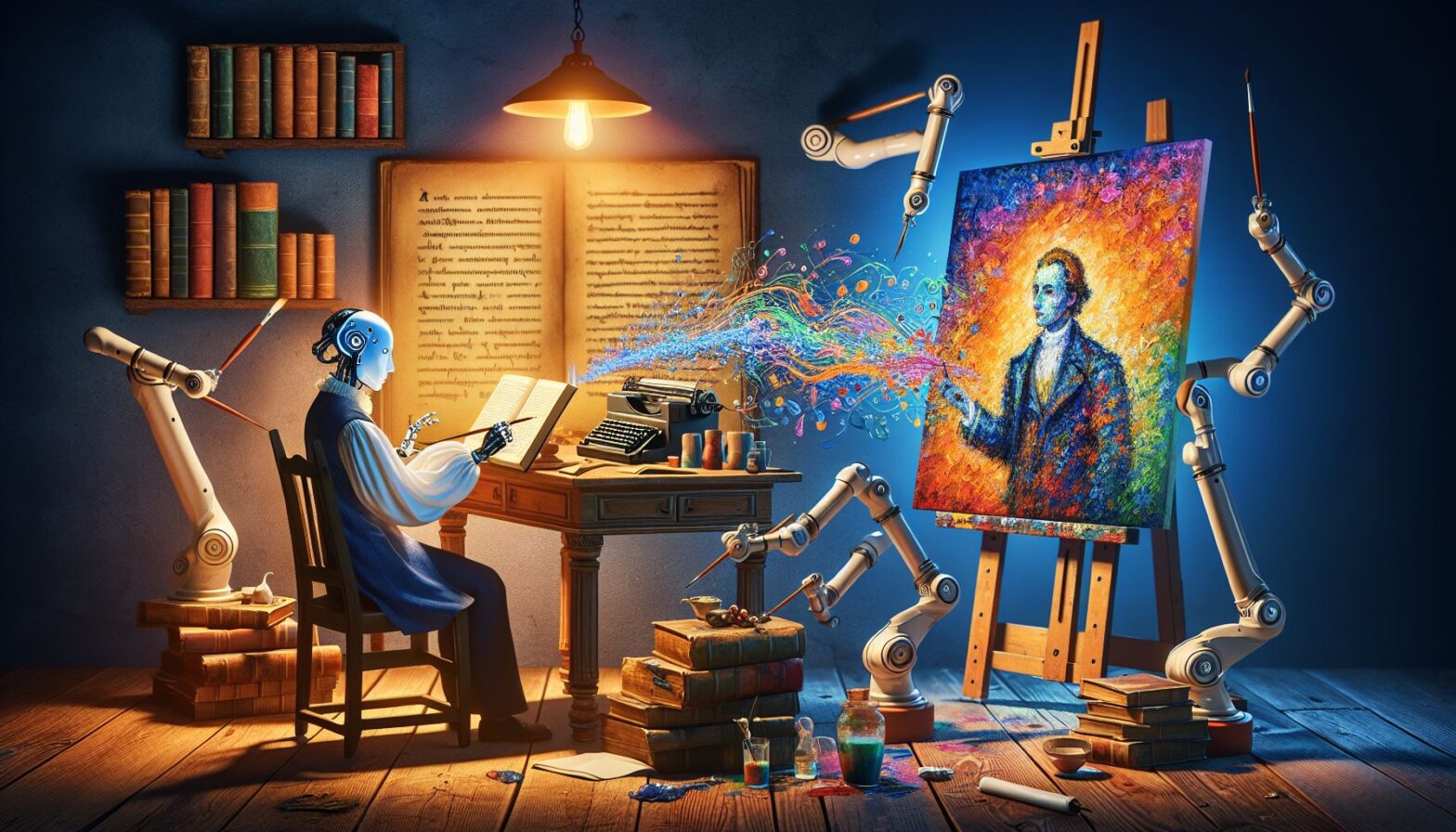
The early 2000s brought us smartphones, social media, and now AI that’s changing everything we thought we knew about creativity. I’ll be honest—when I first heard about AI making art and writing stories, I was skeptical. Would this just be another tech fad, or worse, would it kill human creativity altogether? Turns out, neither. What’s actually happening is way more interesting.
The New Paradigm of Artistic Collaboration
We used to think creativity came purely from human imagination and nothing else. Now AI, with its neural networks and machine learning, is becoming a creative partner in everything from graphic design to writing novels.
AI in Visual Arts
AI has become an unlikely creative partner for artists around the world. Using generative models like GANs (Generative Adversarial Networks), artists and developers can create visuals that push creative boundaries in ways I never expected. These systems analyze thousands of artworks and photos, learn different styles, then generate completely new pieces. Platforms like DeepArt and RunwayML make these tools available to anyone—you don’t need to be a programmer to experiment with AI art. What really gets me is that AI can now create original artwork on its own, which makes us question what creativity even means anymore.
AI in Writing
In the writing world, tools like OpenAI’s GPT have changed how we think about storytelling. These AI models can draft articles from a simple brief, write poetry in different styles, and generate text that sounds surprisingly human. New platforms built on these models help with plot ideas, character development, and even marketing copy. Some writers worry that AI-generated text lacks emotional depth—and honestly, sometimes it does. But others find it genuinely helpful for getting unstuck or exploring new ideas.
Enhancing, Not Replacing: The AI Effect on Creatives
Bridging Human-AI Creativity
Here’s what I find most exciting: AI’s role in creative work is less about replacement and more about collaboration. We’re moving toward what I call symbiotic creation, where human creativity guides AI’s processing power to produce art that neither could make alone. This creates a working relationship where artists and writers focus on the big-picture concepts while AI handles the repetitive or technically complex stuff.
A Playground for Experimentation
Machine learning has opened up incredible opportunities for creative experimentation. Designers can test hundreds of variations in an afternoon. Writers can explore interactive storytelling with real-time AI feedback on different narrative paths. Musicians are creating new sounds with AI composers that generate harmonies and rhythms no human would think to try. The creative problem-solving potential here is genuinely exciting.
The Democratization of Creativity
Accessibility to Creative Tools
One of AI’s biggest gifts to creativity is making advanced tools accessible to everyone. Professional-level capabilities that used to require expensive software and years of training are now available through user-friendly interfaces and often free platforms. Online AI art generators and writing assistants give amateur creators access to techniques that seemed impossible just a few years ago.
Economic Implications
As AI becomes more common in creative industries, small businesses and startups can compete with bigger companies more effectively. Graphic designers, writers, and video creators can produce high-quality, diverse content without massive budgets. This levels the playing field in ways that benefit independent creators and smaller organizations.
Ethical Considerations and the Future of AI Creativity
Navigating Intellectual Property Rights
AI in creative work brings up tricky questions about ownership. If an AI tool plays a major role in creating artwork, who gets credit—the artist, the AI, or the AI’s developer? This puzzle requires us to rethink laws and standards in a rapidly changing creative world, especially around fair recognition and payment.
Ensuring Diversity and Inclusivity
There are real concerns about bias in AI models trained mostly on Western art and literature. These systems can perpetuate narrow worldviews and exclude diverse cultural perspectives. Making sure training datasets represent different cultures and viewpoints is crucial for maintaining creative diversity and avoiding creative homogenization.
Preparing for a Hybrid Future
As AI capabilities grow, we’re heading toward a future where the most valuable skills combine technical AI knowledge with creative intuition. Education systems need to adapt, teaching new generations to use AI tools effectively while developing uniquely human abilities like critical thinking and creative vision.
Conclusion: Embracing the Creative Renaissance
We’re just getting started with AI-enhanced creativity, and the possibilities excite me. Human creators working with AI-powered tools can push past old limitations to tell better stories, create deeper artistic expressions, and explore new forms of visual and audio art. As a democratizing force, AI is opening doors for more diverse voices in the global creative community.
Looking at AI’s current and future impact, this technology-driven change isn’t just about machines making art or writing—it’s enabling new collaborations, expanding creative possibilities, and challenging us to rethink what creative genius means in the digital age.
As AI continues advancing, the key lesson for creators and technologists is to embrace this change with curiosity rather than fear, building a world where technology and human creativity work together and strengthen each other.