
When a Competitor’s Standard Becomes the Industry’s Foundation
I have watched enough technology cycles to know when something has crossed from “interesting experiment” into “infrastructure that matters.” The Model Context Protocol, open-sourced by Anthropic in November 2024, is one of those inflection points. What started as an internal solution to a specific problem has grown into something approaching a genuine standard for how AI agents consume structured context. The fact that OpenAI announced MCP support for its API and Agents SDK in early 2026 tells you everything you need to know about what happens when a working solution solves a real problem better than the alternatives.

This is not hype. This is what pragmatism looks like when it wins.
The adoption curve has been steep enough to warrant attention from anyone building or planning to build on top of large language models. By early 2026, the major developer-facing tools had already integrated MCP support: Cursor, Zed, Replit, and JetBrains IDEs all moved to adopt it. The MCP GitHub repository accumulated over 28,000 stars and spawned hundreds of community-built server implementations covering databases, APIs, file systems, and developer tools. That is the velocity of something that solves a genuine problem at scale.
Understanding the Architecture That Makes It Work
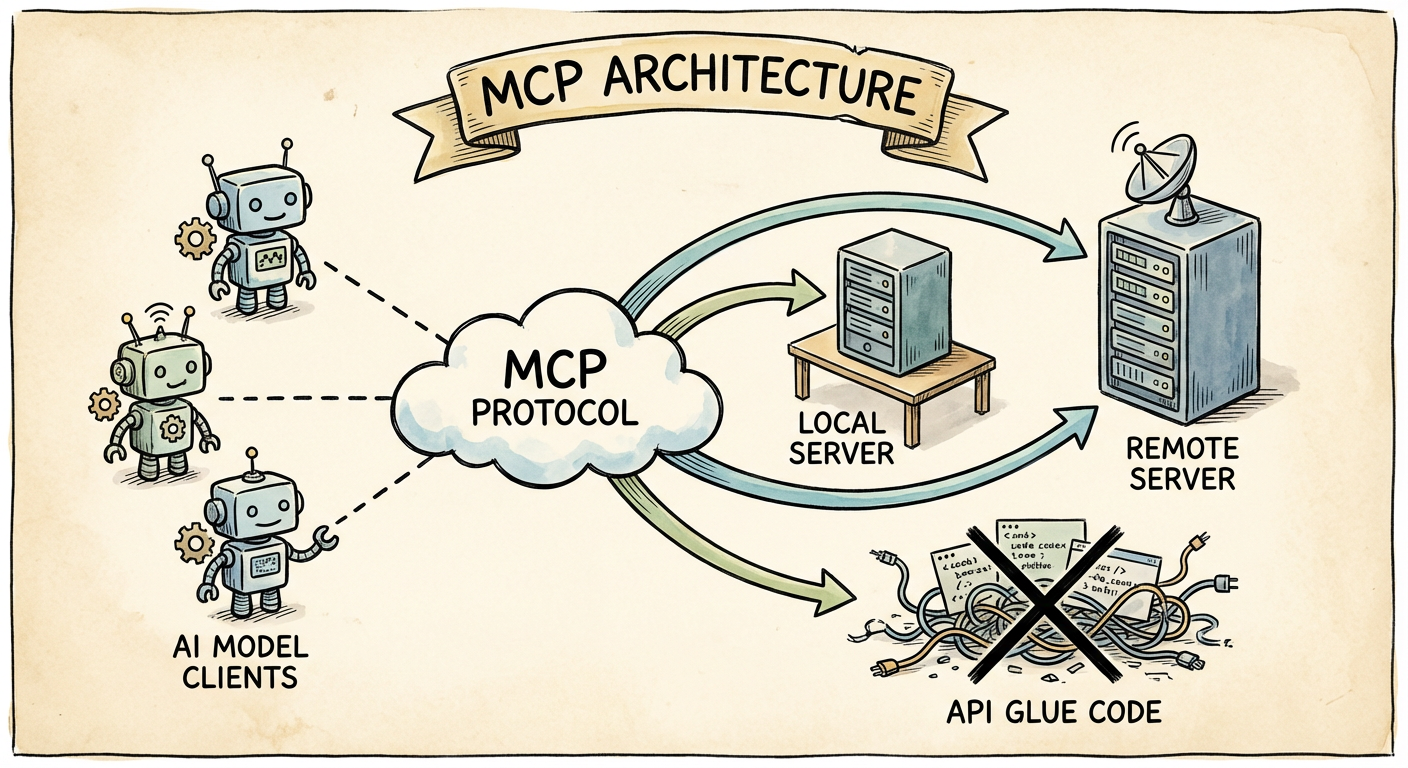
Before we talk about why MCP matters for your career or your projects, let us be precise about what it actually does. MCP operates on a client-server architecture where AI models act as clients consuming structured context from local or remote servers. That is the core insight. Instead of asking developers to build custom integration points between their tools and AI systems every time they want an agent to have context about their codebase or their database or their API, MCP provides a standardized interface for that conversation.
Think about what this solves. In the old world, you would write an agent that needed to understand your company’s internal documentation. You would build a custom wrapper. Then you would need the same agent to query your database. Another wrapper. Then your file system. Another wrapper. The friction is real and it compounds. MCP flips this: you define a server that exposes your system’s capabilities through MCP, and any MCP-compatible client can consume it. The model becomes the client asking questions. The context lives in standardized servers. No custom glue code for each new integration.
This is the kind of architectural clarity that does not emerge from first attempts. It emerges from teams who have lived inside the problem long enough to know what minimal looks like.
Enterprise Adoption as a Signal of Maturity
The early enterprise adopters paint a picture of where this is heading. Block, formerly Square, deployed MCP to connect Claude-based agents directly to internal codebases and documentation systems. Apollo, which deals with complex B2B data infrastructure, used it for similar purposes. These are not small companies experimenting with the latest framework. These are organizations with existing systems, existing governance structures, and existing resistance to replacing things that work. If they chose to build on MCP, it was because the cost of integrating it was lower than the cost of building and maintaining proprietary solutions.
That calculation is the one that matters to your organization. When a Fortune 500 company or a Series C startup reaches that conclusion, it signals that the protocol has matured beyond the stage where you can safely ignore it. It signals that if you are building AI systems into your tooling, you now have to make a deliberate choice about whether to build on top of MCP or explain why you did not.
From a career perspective, this is the moment to understand what MCP is and how it works. Not as a trendy thing to list on your resume, but as a foundational technology that is going to be embedded in the development tools you use for the next five years, the same way WebSockets or REST became foundational before you even thought about them consciously.
The Documentation and Community Ecosystem Matter More Than the Spec
One thing I have learned after years of watching protocol adoption: the spec itself is rarely the bottleneck. The bottleneck is always whether developers can understand the spec, implement against it quickly, and find examples of others doing it. The Anthropic Model Context Protocol documentation is well-organized and readable. More importantly, the GitHub repository shows hundreds of reference implementations. Someone has already built an MCP server for your database. Someone has already built one for your API framework. That is the difference between a protocol that remains academic and one that becomes embedded in practice.
The community layer is where this becomes real. When you are evaluating whether to adopt MCP for your team, you are not evaluating the protocol in isolation. You are evaluating the ecosystem of servers, the quality of the tooling support, and the depth of the documentation. All of those are mature now. The entry cost has dropped significantly.
What This Means for Your Technical Trajectory
If you are building AI agents or AI-augmented developer tools, MCP is no longer optional context. It is either your foundation or it is something you have deliberately chosen not to use. That decision should be explicit and informed. If you are evaluating LLM platforms or integrations for your organization, MCP support is now a legitimate selection criterion. It is the kind of thing that will matter when you want to connect multiple tools to the same agent.
The USB-C comparison is apt. USB-C did not win because it was technically perfect. It won because enough major manufacturers got behind it, the ecosystem consolidated around it, and the friction of adoption became lower than the friction of maintaining alternatives. MCP is following that trajectory. The difference now is that we can see it happening, and we can make deliberate choices about how we engage with it.
The practical wisdom here is old but worth stating: pay attention to what the serious builders are using, understand why they chose it, and think carefully about whether your situation aligns with theirs. That is how you stay ahead of technological shifts rather than reacting to them after they have already happened.