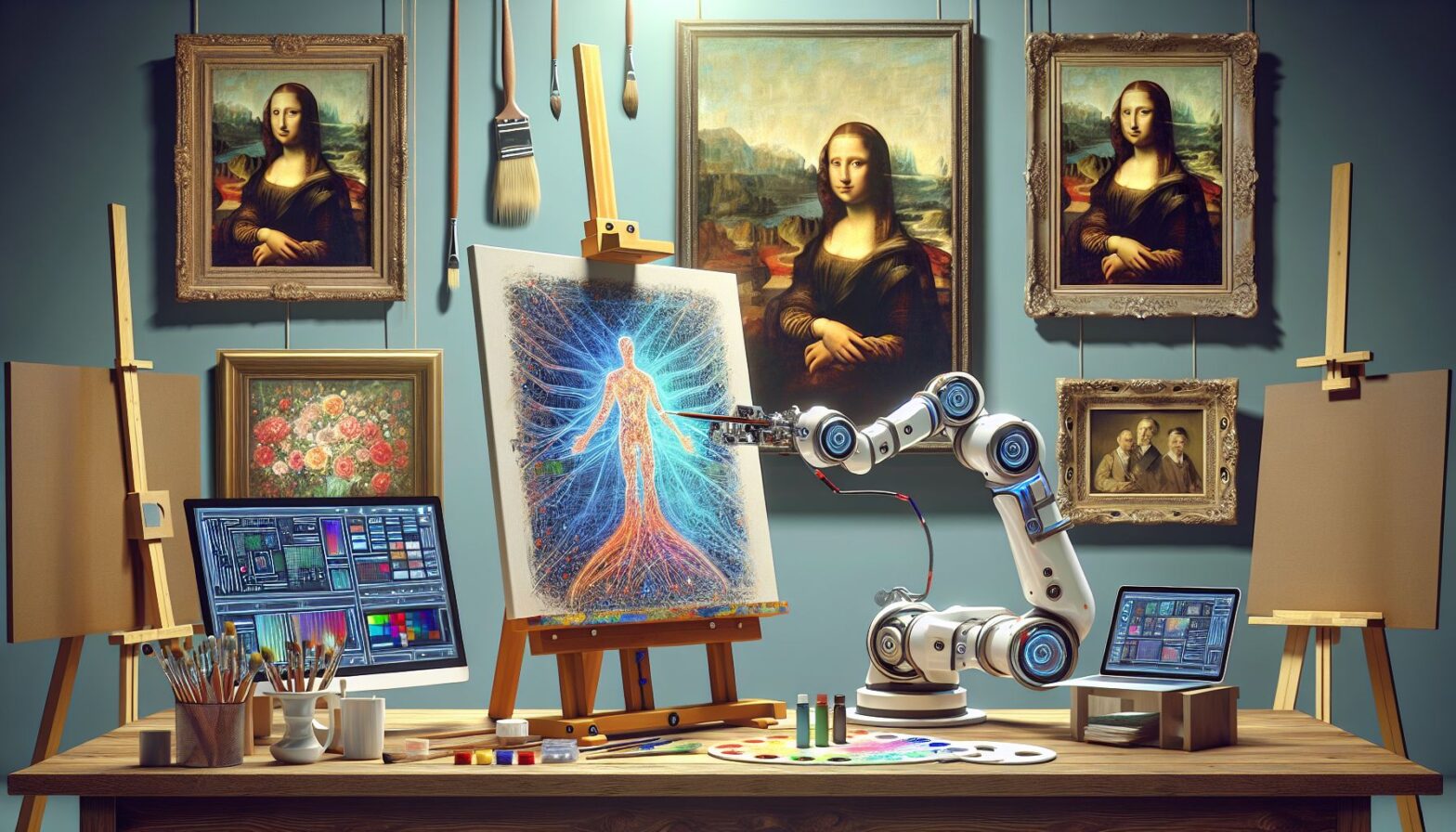
Hey tech aficionados and curious minds, welcome back to another installment of our deep dive into the tech marvels that are actually changing things! Today, we’re peeling back the layers of a topic that’s sending ripples through the art world and shaking up how we think about creativity: Artificial Intelligence in the Creative Arts.
Art Meets Algorithms
Let’s set the scene: you’re at an art gallery, sipping a glass of overpriced wine and pondering a striking piece hanging on the wall. It’s complex, layered, and it somehow speaks to a part of you that only great art can reach. And then you find out it was created by an AI. Mind-blowing, right? This scenario isn’t from a sci-fi novel. It’s happening now, thanks to advancements in AI that have artists, programmers, and art lovers all buzzing, and occasionally, scratching their heads.
A Brief Journey Through AI Art History
Though AI art might seem like a recent trend, it’s been percolating for decades. It actually dates back to the 1960s, when pioneers like Harold Cohen began exploring computer-generated art with programs like AARON. Fast forward to today, programs like DALL-E, DeepArt, and Google’s DeepDream are the Picasso of pixels. We’re standing at the forefront of a revolution where machines aren’t just tools. They’re collaborators in our creative process.
The Tech Behind the Magic
Now, let’s dig into the techno-wizardry making all this possible. AI-generated art primarily relies on something called Generative Adversarial Networks, or GANs. Don’t worry, we won’t go full nerd here. In layman’s terms, a GAN has two neural networks, imagine them as frenemies, competing to create and critique art until one produces something genuinely innovative.
Ever heard of StyleGAN? Developed by NVIDIA, this tech has been responsible for some of the most realistic AI-generated works to date. It’s like having a digital canvas that evolves with each stroke it receives. By blending artistic styles and inventing new textures and forms, GANs are bringing us into an era where digital chaos births stunning order.
Unleashing New Potentials
Alright, let’s address the sparkly elephant in the gallery: What does AI in art mean for the creative community? Are artists doomed? Spoiler alert, they’re not.
Elevating Human Creativity
AI is changing the game, not the players. Much like the camera once challenged the role of painting while ultimately boosting creativity, so too is AI provoking artists to think outside the box. Many are already seizing this new brush. An artist might use an AI to generate thousands of variations of a concept quickly, sifting through ideas that might’ve taken months to explore manually. Saving time? Check. Expanding imagination? Double-check.
Collaborative Canvas
One of my favorite developments in this realm is the concept of AI as a collaborator. Digital artist Sougwen Chung, for example, works with robotic arms guided by machine learning algorithms to create mixed-media pieces. It’s like the cosmic birth of a 21st-century Da Vinci and a mechanical Michelangelo working in harmonious concert. This blending of man, machine, and muse is at the soul of what makes this era so thrilling.
Navigating the Ethical Labyrinth
With all its potential and pizzazz, the intersection of AI and art isn’t without its pitfalls. Remember that time AI accidentally plagiarized human masterpieces, and everyone collectively lost their minds? Yeah, the ethical concerns are real. How do we define authorship in AI-created art? Who takes credit, and more importantly, who gets paid?
Several artists have voiced concerns about AI-generated replicas and the potential devaluation of human artistry. The key will lie in evolving legal frameworks and establishing transparent guidelines, ensuring that while the AI art renaissance blooms, it respects the very human heart of creativity.
The Future Canvas: Speculations and Innovations
As we wrap up this exploration of the AI art world, let’s throw on our speculation hats and gaze into the pixelated crystal ball. The trajectory points to a deeper integration of AI in every brushstroke of our creative future. Imagine augmented reality art exhibits that evolve with every viewer or personalized AI art where the art adapts to your mood.
More tech companies are likely to throw their algorithms into the ring, crafting new tools for artists and studios. We could see AI art marketplaces where the creators are not singular entities but rather neural networks honed to craft what their human counterparts have taught them.
Closing Thoughts
So, are we living in a techno-utopian future where AI crafts the artscape of tomorrow? Absolutely. But much like any tool, AI is only as good as the hands that wield it. The balance of art will always teeter on the edge of chaos and order, with technology adding new colors to our palette. Whether AI will be your brush or your rival is entirely up to you.
That’s a wrap for today’s post, folks! Remember, the next time you’re admiring a piece of art, it might just be the labor of love between an artist and their digital aide. Until next time, stay curious and keep exploring this brave new world!
Now, what are your thoughts on AI art? Would you hang one above your mantel? Let me know in the comments!
Related: The Future of Longevity: Living Longer with a Side of Tech